

The Television and Fireplace Location Dilemma
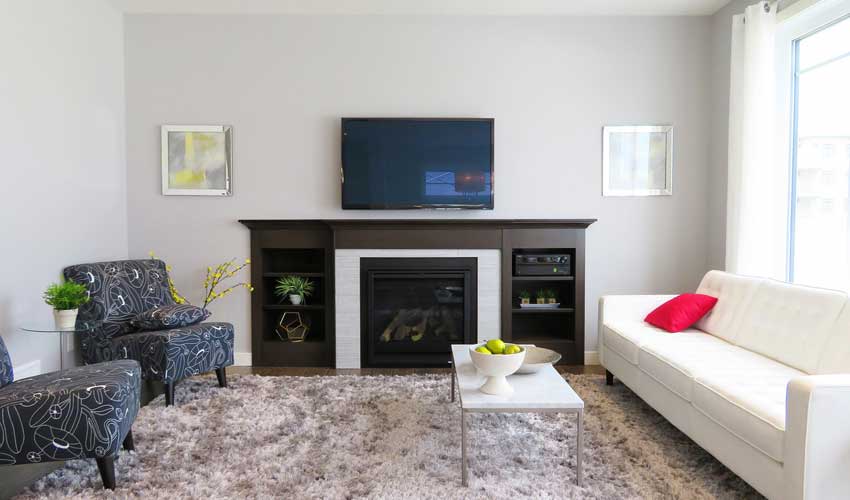
Your Family Room or Great Room may be difficult to design if you want to arrange furniture to view television and your fireplace at the same time. You are presented with what I call the Television and Fireplace Location Dilemma.
Traditionally, fireplaces were placed in the center of the wall. The furniture was then grouped around it. When television first entered the American home, the screens were small and the television was simply another piece of furniture. Today, television screens are large and arguably the most prominent feature in the room. Usually the television is placed on another wall, so it has enough space. But this means your furniture arrangement must “aim” at both the fireplace and television at the same time. This is pretty hard to do. One poor solution that often is presented is to place the television above the fireplace. This helps with the furniture arrangement, but placing the television at this height only works if you are lying in bed while watching. If you are seated in a sofa or a chair, this is too high and puts an uncomfortable strain on your neck. Are there any other solutions to this dilemma?
One way to get the fireplace and television on the same wall is to not put either one in the exact center of the room and to think of them as a combined element.
In one house I designed recently, we built one wide “pillar” of stone from floor to ceiling and put the fireplace opening in the right half and the television in a cabinet recessed into the stone on the left half. Then we centered the entire stone element in the room. Neither the television nor the fireplace was exactly centered in the room, but both ended up in good positions for seeing them while seated in the furniture grouping. Your eye reads the combined assembly and sees it as “centered” in the room and on the wall. You could do the very same thing without the stone and instead creating with a projecting drywalled element. Or, the grouping of the fireplace and television could be built into a paneled, cabinet-like assembly that would achieve the same goal.
Thinking of the television and the fireplace opening as being parts of a larger, unitized element will make the arrangement easier to handle and much more successful. You’ll be able to arrange your furniture around this combined architectural element and have perfect viewing positions for both the television and the fireplace.
(Note: Images to be added soon)
UPDATE – I’ve gotten several requests for a photo that describes the fireplace and television cabinet combination I am describing. I’ve inserted it above. Hope it helps explain the concept.
ADDITIONAL UPDATE – Here is another arrangement of a television and fireplace combination that still preserves the traditional mantel look.
I hope this information is helpful to you. You might want to get yourself a copy of my best-seller, Designing Your Perfect House. It is chockfull of valuable tips and advice that will save you many times the cost of the book on your house building or remodeling project. You might also like The Well-Centered Home: Simple Steps to Increase Mindfulness, Self-Awareness, and Happiness Where You Live. It will show you how to make your home a happy place.

We will be building a house in a year and a half. I am, however, starting my process now, and your book has been VERY helpful!
With this issue, I was thinking of having the fireplace built in a corner, and the tv in the middle, placed on a “built in”. After all, let’s be honest, we don’t sit around a stare at the fireplace all night.
What’s your thinking on this design?
Luci – I think you are right on track. There is no real need to make the fireplace the primary focal point in a room. A corner location will make the fireplace less directional and allow you to arrange the furniture around the “real life” focal point, the television.
Thank you, I’m glad to hear your opinion. And I was also SO glad you are against putting the TV above the fireplace. People think this solves the focal point dilemma, but it is so very uncomfortable.
I would like to ask a question about the outside “siding” of a house. I love the look of stone, and I think that stucco look goes with it. However, where we will be building, in Maryland on the water, all the info we have gotten warns against the stucco. I don’t HAVE to have stucco, but something that resembles that look. Do you have any suggestions?
Maybe it can be a blog?
BTW, I have just recently started my own blog, “Designing Our Retirement”, where I hope to share our journey along the searching, buying, and building process. Your book has helped me so much, it was the best investment I ever made! Your advice has been invaluable, and I just want to thank you for sharing your design knowledge with us.
Luci – Thanks for your kind comments about my book. It is really great to hear that it has been so helpful to you. And I did check out your blog. It looks like it will be very interesting.
Your suggestion about using the stucco issue as a blog post is great. I’ll write that up soon. In the meantime, let me give you the short answer. I have had really great success with stucco, even in coastal locations. I used stucco on a house in Hawaii, right on the water on the windward side of Oahu. You can’t get any more salt and water exposure than that. The waves were only about thirty yards away and the wind blows nearly every day. Everything suffers in that environment. It is ten times worse than the Atlantic coast. During construction, we had rain blow all the way through the house. But the stucco has held up fine and is a commonly used material there.
The warnings you have gotten about stucco probably are a reaction to the synthetic stucco failures that brought large law suits some years ago. In these cases, the builders depended on the stucco as the waterproofing of the walls. They omitted a layer of Tyvek or building paper underneath the stucco. The stucco is actually quite waterproof, so they depended on that. The problem was that water could get behind it by entering through window sills and door head. Once it got in, it could not get out. With water trapped in the wall, eventually the wood began to rot. The stucco got the blame, even though it was not the failing element, the windows and doors were.
Now, no one puts up stucco, synthetic or otherwise, without a proper waterproof layer beneath it. And in most cases, the stucco used is the type called “hard coat.” This is the traditional three part cement stucco used for centuries. Traditional stucco had the problem of being inflexible and prone to getting cracks. Now, the cement has epoxy additives that give it more tensile strength and cracking is not an issue.
Stucco done right will give you a long lasting exterior material that will not fade or deteriorate. I would not hesitate to use it.
Bill,
Do you have pictures posted anywhere of the combined tv/fireplace focal point. My wife and I are building a new home and I’m really struggling with where to put the fireplace and tv in the room. I don’t want the tv above the fireplace for viewing reasons. My wife wants to move the fireplace from a side wall to the end of the room, but that would cause us to lose a window and we would end up with two focal points, the fireplace at the end of the room and the tv on a wall perpendicular to it. Your idea of a combined fireplace/tv unit side by side, sounds perfect but I haven’t been able to find anything like it on the web. FYI, our room is 15’x18′, one 18′ side open to the kitchen, the other solid with a fireplace, one 15′ section solid wall, the other with three windows. Thanks!
Craig – I’m working on that. Check back in a few days and hopefully I’ll have some computer images of what I’m talking about.
Bill,
Were you able to come up with anything?
My husband and I have bought a house with a through lounge measuring 32’x13′. I plan to ‘separate’ the space with furniture to provide a living and dining area, however I also have the fireplace/TV dilemma.
My instinct is to use the bay window end of the room as the living space with the couch and TV and the other end as the dining room however I can’t seem to find a place to position the TV without detracting from the fireplace or having the back of the couch facing the double doors.
I have (poorly!) indicated below a rough idea of how the room looks and wondered what you might suggest in terms of placement of furniture?
Any help will be gratefully received!
Thanks!
_____________Bay Window______________
I
D D I
o o F p I
u o i l I
b r r a I
l s e c I
e e I
I I
I I
I I
I I
I I
I I
I I
I I
I I
I I
Sliding doors to l-shape kitchen
Oh dear…just realised my diagram has become all muddled after I’ve submitted my comment…will see if I can do something else to give you a better idea!
Thanks!
Not having much luck, so hopefully, my description may help:
North end (horizontally): bay window
East side (vertically): Top end: Fireplace
Bottom end: Wall
South end (horizontally): Double glass sliding doors
West side (vertically): Top end: Double glass sliding doors
Bottom end: Wall
Danielle – Try sending me an e-mail at and attaching your sketch. That should help me see what you’re envisioning. I’ll try to help you out.
Bill,
I love your idea of combining the tv & fireplace; however, I have windows on each side of the fireplace so could you give me some other idea of how to combine the two without putting the tv above the fireplace.
Brenda – If the sill of your windows is high enough, you could build in some cabinets beneath the windows. One of them could hold the TV. The TV could be installed within the cabinet on a lift that would let the TV rise up automatically when you wished to view it and lower into the cabinet when you did not want to see it. I did this once with a situation like yours on a house I designed in Connecticut.
The best known manufacturer of lifts like this is Auton. The lifts are fairly expensive. But it might be worth it if it solves your TV versus Fireplace stand-off. And yout friends and family will think it’s soooo cool!
Bill-
We are building a home and are facing the fireplace TV dilema. We don’t want to put the TV above the fireplace either. The wall is in a great room with a 30′ vaulted ceiling. The wall is 18′ wide with nothing else on the wall. Your design was a God-sent as we have tried to figure this out. At this point we are trying to design the piece. We figure it will be about 12′ wide and 9.5′ high with a crown molding-type wood cap on top. Part of the problem we are running into is that the depth of the stone and the width of the doors need to coincide if one hopes to have them slide into the cabinet (as I believe the ones in your pic do). However, your doors seem wider than the thickness of the stone (make sense?). Is it possible to frame some extra room into the wall behind the cabinet so that the doors have more room to enter? Do you happen to have any additional pictures or measurements of this entertainment center that may give a better idea about how you balanced the sizes of the different components?
Thanks again for the great article.
Nick
Nick – I’m glad my article helped. With the wide format flat screen TV’s we often need to create a false back for the doors and figure out a way to create depth for the doors to slide back into. One other solution is to use lifting hardware the lets the panels of the door lift up )covering the shelves above the TV) and pull down to cover the TV. Hafele makes some nice hardware for this. It is counterweighted so it is easy to operate. Download the Hafele cabinet hardware catalog and check out Hafele EKU-LIBRA 20H.
I don’t have any more drawings of this concept that are ready to go. A lot depends on the size of the TV you want or have. You could probably get the cabinetmaker, architect, or builder to sketch something (to scale) to see how it might all go together. I’m working on one for another client right now. When the drawings are done, I’ll add it to this post.
Bill- Thanks for the response. I was thinking the same thing about using wall space to let the doors slide into. I don’t think we will have much room to play with. The only concern about the doors not going all the way back is that it would be difficult to view from the side. From what I understand, the envelope doors are never totally flush when pushed back. One solution we are considering is allowing the shelf that the TV is on to roll / slide out a few inches if needed. Make sense? Does that seem practical?
I will be looking forward to your drawings. Thanks again for your input.
Nick – You are correct that the retracting doors never go in all the way. If you have a flat screen TV, you might consider mounting it on a bracket on the back panel. The bracket could be the “articulating” type which would let you pull the TV out and angle it easily. This is often easier and safer than a pull out shelf with the TV sitting loose upon it.
Bill,
I own your book, and it has given me lots of great ideas for our addition build that is in progress. I wondered if you have any more sketches, pictures or measurements on your clever TV/fireplace combo solution?
Thanks! Carol
Carol – I added a photo to the blog post of another way to do this television and fireplace combination. This arrangement preserves the traditional mantel while still creating a total built-in assembly. Neither the TV nor the fireplace are centered on the room. But the combination of the two are centered on the room. This creates a balanced composition without the rigidity of symmetry.
Bill- The months have gone by and we just moved into our new home. I created a very similar fireplace/tv combo like the original one you have posted above in the blog. It turned out great and has generated many compliments. It is a little different and incorporates more wood on the mantle and a crown around the top since we have a high vaulted ceiling. I would like to send or post a pic for you to share if you would like. Your design is great and this shows another successful version. Thanks again for the inspiration!
Nick – Terrific. I would love to see it. You can email the photo to . I’ll add it to the blog post so everyone can see it. Let me know what credit/name you might like on the photo, if any.
Bill-
I have tried to send the pics to the address above but I get an error saying that the mailbox is full….
Nick
Nick – Try sending them to . We’ll try to figure out what’s wrong with the other email address.